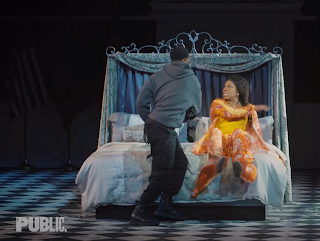
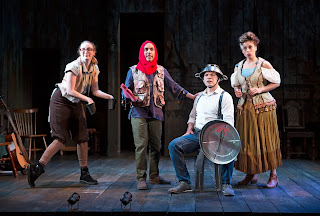
Euripedes won The Dionysius Festival award for Best Tragedy award in 405 BC (a year after his death) for The Bacchae. This year, New York’s Public Theater is producing it as part of its Shakespeare in the Park program. They can be excused for the anachronism…
The Bacchae isn’t the best Greek tragedy. Most of the action has already taken place before the play begins, or else it takes place offstage and we hear about the events through reports. This is perhaps just as well, since that action includes murder, dismemberment and other unpleasantries.
Nonetheless, director Joanne Akalaitis and her cast make a notable, not splendid, production out of the script. Jonathan Groff plays Dionysius, the god disguised in jeans as a mortal, with the effeminate sexuality of Jim Morrison, and well done. Joan Macintosh has the production’s bravura moment as Agave, when she discovers that she’s murdered her son and is, indeed, holding his skull in hands. A classic Greek recognition. She lets out a prolonged shriek worthy of Fay Wray (King Kong), and she melts like the Margaret Hamilton (Oz). It’s marvelous moment of histrionic abandon.
Unfortunately, the other principles are no more than serviceable. But the production’s best moments occur during the choral odes, the most challenging passages of any script. Akalaitis has put her women – they’re all women – in red sort-of pantaloons, and she’s given them marvelous movement that is not merely blocking but not yet dance. They’re almost always doing the same thing physically, but the movement choices leave each an individuality.
Best of all, they sing the odes, intelligibly and demonically, to Philip Glass’ fascinating, pulsating music. The four musicians play three brasses and percussion, and the sound is commanding and elegantly simple.
The set of this direct, minimalist production has an upstage of non-parallel bleaches. They form beautiful lines, but they have an incomplete look. Dionysius’ long opening monologue is spoken before a smoking geyser and, later, a thin volcanic crevice appears running the depth of the stage, red from inner lighting. Terrific!
Thursday, August 27, 2009
Wednesday, August 5, 2009
Trilogia della villegiatura - from Italy
As part of the Lincoln Center Festival, the Piccolo Teatro di Milano and the Teatro Uniti di Napoli presented Carlo Goldoni’s Trilogia della villegiatura (in Italian with English supertitles). Goldoni was an 18th century Venetian, and his plays – there are more than 100 of them - are Italian classics. He wrote in a comedy of manners, satirizing his society. The plot of Trilogia concerns two bourgeois families and their circle. They spend a vacation in the country replete with romantic entanglements.
Under the direction of Toni Servillo, this production gives the script a rich, refined mise-en-scène. When the actress peers into a bin, she bends from the waist, and her back forms a lovely curve. This concern with gesture is clear throughout the play; the actors isolate movements and invest them with italianite grace.
The sets reflect the refined aesthetic, with hanging vines and a gorgeous yellow sun. The lights pour a dappled rural pattern on the stage floor. And there are the sound of crickets and thunder, to complete the texture.
Goldini developed Italian theatre away from commedia del arte, but we can see its ghosts on stage. The lead characters are tall and handsome; the minor characters – the clowns – are short and dorky. There’s a fool catching flies. Upstage of the other characters, he’s a comment on them as well as one of them.
Concerned largely with food and card-playing, the characters are drowning in trivialities. But the script rises above the trivial. The characters’ fashion-centered superficiality, their utter uselessness, is a timeless theme, as is their overspending. Money, of course, is our perennial concern.
But foremost in this play is the concern with convention. Betrothed to one man but in love with another, our heroine marries not for love, but for duty. Or is it for appearance? “One must choose honor before life,” she tells us. But also “My reputation’s at stake. It’s too horrible to consider.”
In Goldini, dialogue had not yet developed subtlety. Characters explain their emotions, and the texture of their conversation is more self-conscious than natural. But when the actress says “Te amo… te amo… te amo…,” we want nothing else in the world.
- Steve Capra
July 2009
Under the direction of Toni Servillo, this production gives the script a rich, refined mise-en-scène. When the actress peers into a bin, she bends from the waist, and her back forms a lovely curve. This concern with gesture is clear throughout the play; the actors isolate movements and invest them with italianite grace.
The sets reflect the refined aesthetic, with hanging vines and a gorgeous yellow sun. The lights pour a dappled rural pattern on the stage floor. And there are the sound of crickets and thunder, to complete the texture.
Goldini developed Italian theatre away from commedia del arte, but we can see its ghosts on stage. The lead characters are tall and handsome; the minor characters – the clowns – are short and dorky. There’s a fool catching flies. Upstage of the other characters, he’s a comment on them as well as one of them.
Concerned largely with food and card-playing, the characters are drowning in trivialities. But the script rises above the trivial. The characters’ fashion-centered superficiality, their utter uselessness, is a timeless theme, as is their overspending. Money, of course, is our perennial concern.
But foremost in this play is the concern with convention. Betrothed to one man but in love with another, our heroine marries not for love, but for duty. Or is it for appearance? “One must choose honor before life,” she tells us. But also “My reputation’s at stake. It’s too horrible to consider.”
In Goldini, dialogue had not yet developed subtlety. Characters explain their emotions, and the texture of their conversation is more self-conscious than natural. But when the actress says “Te amo… te amo… te amo…,” we want nothing else in the world.
- Steve Capra
July 2009
Life and Fate - from Russia
The production of Life and Fate presented in New York as part of the Lincoln Center Festival is from The Maly Drama Theatre, St. Petersburg, Russia. It’s adapted from Vasily Grossman’s celebrated Russian novel of that name, set during World War Two. There are various Russian locals, but the chief setting is a Moscow apartment. Its occupants are the family of a nuclear scientist, Shtrum, and most of the action of the play concerns his relationship with the Stalinist government. The production is in Russian with English supertitiles.
Lev Dodin’s staging of the play is brilliant, stunning stagework. His stage presents several locales at once fading into one another – the apartment, a work camp, a battlefield… What’s more, the characters show up in scenes where they have no business being. As the camp prisoners discuss cruelty and patriotism, the family is present, surrounding them, listening silently. The battle of Stalingrad takes place literally around the scientist’s bed, he and his wife entangled in love.
The play opens with a recurrent image: the characters – many of whom never meet each other in the action of the play – are silently playing volleyball. The first words come from a woman who is nowhere in particular. She’s the mother of the Jewish scientist, killed by the Nazis, reciting her final letter to him, and she shows up a number of times. These two motifs create mythical moments, outside of the period of the action.
Dodin’s adaptation of the novel exploits the unique strength of theatre and does what a novel cannot do. It reminds us that in any moment other moments present. He shows them to us at once. We’re all connected; we all create a net. A volleyball net.
The play’s chief theme is political. We watch as Shtrum’s relationship with the government reverses, and he’s approved by Stalin. When he asked to sign a document condemning other scientists he capitulates, with “I feel very sorry or you, but your fate is not mine”.
Just as cogent is the flashing between the Soviet work camp and the Nazi POW camp, when the volleyball net becomes a fence. It makes no difference. A camp is a camp, and a dictator is a dictator.
Unfortunately, Dodin has attempted more than any stage can handle, and the play is much too long. There are long speeches and political talk that weigh down the vehicle. And there’s melodrama when the script dwells on points that would be better merely suggested. Shtrum has a long monologue before he loses his integrity, and we don’t need to see this inner monologue.
If Dodin’s staging lacks delicacy, its luscious, complex texture is bold and welcome, an enormously creative method of adaptation.
- Steve Capra
July 2009
Lev Dodin’s staging of the play is brilliant, stunning stagework. His stage presents several locales at once fading into one another – the apartment, a work camp, a battlefield… What’s more, the characters show up in scenes where they have no business being. As the camp prisoners discuss cruelty and patriotism, the family is present, surrounding them, listening silently. The battle of Stalingrad takes place literally around the scientist’s bed, he and his wife entangled in love.
The play opens with a recurrent image: the characters – many of whom never meet each other in the action of the play – are silently playing volleyball. The first words come from a woman who is nowhere in particular. She’s the mother of the Jewish scientist, killed by the Nazis, reciting her final letter to him, and she shows up a number of times. These two motifs create mythical moments, outside of the period of the action.
Dodin’s adaptation of the novel exploits the unique strength of theatre and does what a novel cannot do. It reminds us that in any moment other moments present. He shows them to us at once. We’re all connected; we all create a net. A volleyball net.
The play’s chief theme is political. We watch as Shtrum’s relationship with the government reverses, and he’s approved by Stalin. When he asked to sign a document condemning other scientists he capitulates, with “I feel very sorry or you, but your fate is not mine”.
Just as cogent is the flashing between the Soviet work camp and the Nazi POW camp, when the volleyball net becomes a fence. It makes no difference. A camp is a camp, and a dictator is a dictator.
Unfortunately, Dodin has attempted more than any stage can handle, and the play is much too long. There are long speeches and political talk that weigh down the vehicle. And there’s melodrama when the script dwells on points that would be better merely suggested. Shtrum has a long monologue before he loses his integrity, and we don’t need to see this inner monologue.
If Dodin’s staging lacks delicacy, its luscious, complex texture is bold and welcome, an enormously creative method of adaptation.
- Steve Capra
July 2009
Boris Godunov - from Russia
Declan Donnellan is a Brit, but he’s staged Pushkin’s Boris Godunov (1825) with a Russian company from The Chekhov International Festival. It was presented a part of The Lincoln Center Festival at The Park Avenue Armory, in Russian with English supertitles. It was wonderful, satisfying theatre, as crisp and pointed as Pushkin’s blank verse.
Godunov was the Russian czar around 1600. Pushkin took as fact the belief that he had murdered the Czarevitch Dmitri, the child son of Ivan the Terrible, to gain the throne. The antagonist is a monk who pretends to be Dmitri grown (czarevitch as survivor) and mounts an army with the help of Polish nobles. The plot is the story of his assault on Boris’ czarist forces, Godunov’s death from conscience, and the pretender’s victory.
It’s said that this play inspired Macbeth, and indeed, the script is like a lean Shakespearean tragedy. Like Shakespeare, Pushkin shows us all of society, from the court to the tavern. The descent to the common allows for comedy when the bar staff deal with both soldiers and a drunken bully. What a choice of devils!
The Shakespearean overtones are explicit when the supertitle translation reads “Oh, what a noble mind!” as a court official refers to Gudonov. The line is from Hamlet, but the point holds.
Like Shakespeare, as well, Donnellan mixes periods to keep the theme current. On throne, His Royalness looks as czarist as we could want in rich robes, but off-duty he and his men wear suits. The pretender and his aristocratic retinue wear tuxedos. The battles, of course, are designed with the unmistakable military uniform.
From the opening, with eight cowled monks and the scent of incense, the production is spare in design and rich in effect. In the large armory space, the audience straddles the long, narrow stage. The piece is stunning when the monks hold one-foot candles in three-foot holders, and rich in sound when the monks chant under lines. A square of the floor is removed to produce a pool for the scene when the monk-turned-politico woos his mistress, and the political becomes the personal in her ambition.
This elegant, simple production runs only about two hours, yet manages to present a great scope. However Pushkin might have imagined the staging, Donnellan has the advantage of being able to draw from Brecht’s techniques. It’s through the simple suggestiveness of epic theatre that drama manages to be, well, epic, and still retain dramatic tension.
And so when Pushkin’s characters are in public, Donnellan lights the audience. We become Moscovites - or they become Americans, depending on how you look at it. He keeps the politics immediate with reference to waterboarding when a soldier is interrogated (his head is held in a bucket of water).
The production is never overweight, never slight, never dull and never rushed. It balances its various elements exquisitely.
- Steve Capra
July 2009
Godunov was the Russian czar around 1600. Pushkin took as fact the belief that he had murdered the Czarevitch Dmitri, the child son of Ivan the Terrible, to gain the throne. The antagonist is a monk who pretends to be Dmitri grown (czarevitch as survivor) and mounts an army with the help of Polish nobles. The plot is the story of his assault on Boris’ czarist forces, Godunov’s death from conscience, and the pretender’s victory.
It’s said that this play inspired Macbeth, and indeed, the script is like a lean Shakespearean tragedy. Like Shakespeare, Pushkin shows us all of society, from the court to the tavern. The descent to the common allows for comedy when the bar staff deal with both soldiers and a drunken bully. What a choice of devils!
The Shakespearean overtones are explicit when the supertitle translation reads “Oh, what a noble mind!” as a court official refers to Gudonov. The line is from Hamlet, but the point holds.
Like Shakespeare, as well, Donnellan mixes periods to keep the theme current. On throne, His Royalness looks as czarist as we could want in rich robes, but off-duty he and his men wear suits. The pretender and his aristocratic retinue wear tuxedos. The battles, of course, are designed with the unmistakable military uniform.
From the opening, with eight cowled monks and the scent of incense, the production is spare in design and rich in effect. In the large armory space, the audience straddles the long, narrow stage. The piece is stunning when the monks hold one-foot candles in three-foot holders, and rich in sound when the monks chant under lines. A square of the floor is removed to produce a pool for the scene when the monk-turned-politico woos his mistress, and the political becomes the personal in her ambition.
This elegant, simple production runs only about two hours, yet manages to present a great scope. However Pushkin might have imagined the staging, Donnellan has the advantage of being able to draw from Brecht’s techniques. It’s through the simple suggestiveness of epic theatre that drama manages to be, well, epic, and still retain dramatic tension.
And so when Pushkin’s characters are in public, Donnellan lights the audience. We become Moscovites - or they become Americans, depending on how you look at it. He keeps the politics immediate with reference to waterboarding when a soldier is interrogated (his head is held in a bucket of water).
The production is never overweight, never slight, never dull and never rushed. It balances its various elements exquisitely.
- Steve Capra
July 2009
Monday, June 8, 2009
Sufi Ensembles
Last week, The Brooklyn Academy of Music presented two Sufi Ensembles as part of a program called Muslim Voices: Arts & Ideas, which it co-sponsors.
The Sufi tradition of the ancient and mystical, and its music is sacred - not an end in itself, but a portal to the Divine. In Arabic, it sometimes invokes the Name of God, sometimes draws from the Qur’an, sometimes quotes prayers and poetry.
The Aissawa Ensemble, a revered group from Fez, opened the evening, a dozen men, mostly middle-aged. They entered in parade wearing brilliant striped gold robes, yellow slippers and gold head wraps. Their instruments were drums and horns, including 6-foot horns called n’far trumpets, and hand drums with metal cones that must make powerful resonators. One man struck a large, flat metal bell. Another, who seemed to be a sort of front man, wore a fez, and played a double drum, sometimes raising the drumstick over his head on the upswing as he beat his complex rhythm.
Their first piece used drums and horns only; in the second they chanted in unison (all group vocals in this music are in unison); the third alternated between soloist and group. In a later piece, four of the men danced with poles, striking them together or holding them horizontally to form a square.
This insistent music, sometimes strident, works itself into a frenzy, like some sub-Saharan drumming. Its purpose, after all, is to wake the faithful. The musicians move around the stage, or spun in place with those long horns.
The youngest man danced a loosely-stepped dance, getting on his knees at one point. He was joined by the others, and finally the group was joined by audience members on stage in an ecstatic dance – an act of abandon we don’t expect from the reserved BAM.
Some of this exotic performance remains opaque: the ensemble brought on stage a gorgeous, closed metal container, about three feet tall, a sort of ciborium. Perhaps someone could tell me what this beautiful object was.
____________
The Aissawa were followed by the Tabyah ensemble from Avignon, comprised of 14 men. Their music was more meditative and introspective, sometimes with a mesmerizing repetition. Unlike the Aissawa’s music, it sometimes retarded before it ended, and at one point it had a call-response form. When the soloist sang a capella, he sometimes put a hand over one ear, a lovely, mysterious gesture.
The various instruments included a lute and a bamboo (?) flute, which the men supported, in one chant, with a wordless hum. It all made for a gentle, meditative sound.
While the ensemble played, a calligrapher painted on four tall pieces of black paper with a short, wide brush. Arabic script is extraordinary, and, for me, seeing it was like listening to a beautiful song in a language I don’t understand - which, in fact, I was also doing. Mystery is crucial to art, and in a way we are blessed when we do not understand.
One member of the group was a Dervish, and he added to the evening with his majestic, whirling dance, his robe forming that beautiful white bell that looks so much like a confection, sometimes pulling his white jacket to ear.
What a marvelous concert the evening’s presentation was! What a blessing this music is!
- Steve Capra
June, 2009
The Sufi tradition of the ancient and mystical, and its music is sacred - not an end in itself, but a portal to the Divine. In Arabic, it sometimes invokes the Name of God, sometimes draws from the Qur’an, sometimes quotes prayers and poetry.
The Aissawa Ensemble, a revered group from Fez, opened the evening, a dozen men, mostly middle-aged. They entered in parade wearing brilliant striped gold robes, yellow slippers and gold head wraps. Their instruments were drums and horns, including 6-foot horns called n’far trumpets, and hand drums with metal cones that must make powerful resonators. One man struck a large, flat metal bell. Another, who seemed to be a sort of front man, wore a fez, and played a double drum, sometimes raising the drumstick over his head on the upswing as he beat his complex rhythm.
Their first piece used drums and horns only; in the second they chanted in unison (all group vocals in this music are in unison); the third alternated between soloist and group. In a later piece, four of the men danced with poles, striking them together or holding them horizontally to form a square.
This insistent music, sometimes strident, works itself into a frenzy, like some sub-Saharan drumming. Its purpose, after all, is to wake the faithful. The musicians move around the stage, or spun in place with those long horns.
The youngest man danced a loosely-stepped dance, getting on his knees at one point. He was joined by the others, and finally the group was joined by audience members on stage in an ecstatic dance – an act of abandon we don’t expect from the reserved BAM.
Some of this exotic performance remains opaque: the ensemble brought on stage a gorgeous, closed metal container, about three feet tall, a sort of ciborium. Perhaps someone could tell me what this beautiful object was.
____________
The Aissawa were followed by the Tabyah ensemble from Avignon, comprised of 14 men. Their music was more meditative and introspective, sometimes with a mesmerizing repetition. Unlike the Aissawa’s music, it sometimes retarded before it ended, and at one point it had a call-response form. When the soloist sang a capella, he sometimes put a hand over one ear, a lovely, mysterious gesture.
The various instruments included a lute and a bamboo (?) flute, which the men supported, in one chant, with a wordless hum. It all made for a gentle, meditative sound.
While the ensemble played, a calligrapher painted on four tall pieces of black paper with a short, wide brush. Arabic script is extraordinary, and, for me, seeing it was like listening to a beautiful song in a language I don’t understand - which, in fact, I was also doing. Mystery is crucial to art, and in a way we are blessed when we do not understand.
One member of the group was a Dervish, and he added to the evening with his majestic, whirling dance, his robe forming that beautiful white bell that looks so much like a confection, sometimes pulling his white jacket to ear.
What a marvelous concert the evening’s presentation was! What a blessing this music is!
- Steve Capra
June, 2009
Labels:
Aissawa,
Brooklyn Academy,
music,
Muslim,
sacred music,
Sufi,
Tabyah
Sunday, May 31, 2009
Blue Day at La MaMA
Alessandro Corazzi is an Italian playwright/director. One of his plays, directed by himself, appeared recently at La MaMA. Blue Day is a stage duet: we discover a disgruntled, laid-off factor worker dousing himself with kerosene (timely, no?). A young girl, a teen, passes by and, of course, through her trivial chatter, he passes from a lower state to a higher state, a sort of tragedy in reverse (there should be a term for that).
An opening siren is followed by a film of factory workers, and our anti-hero is discovered wearing a sign saying “I lost”. The actor is suitably morose and defeated, with a disciplined, flat delivery of nearly every line. The young actress, on the other hand, is clichéd and false, and her performance is painful to watch.
At 45 minutes, the play might be engaging if it were directed with insight. Its referrals to labor politics are intriguing, but clumsy. It has mystery in the psychology of both characters, but Corazzi never examines it in directorial terms. The translation doesn’t help, with lines like “Who tells you such nonsense?” There’s an explanatory voiceover that adds nothing. What’s more, the gamine turns into another character or a few moments, and we have no idea what reality she’s in.
Corazzi shows subtlety and creativity by having the poor fellow ascend from despair to desperation – no higher. And there’s a surreal sequence at the end that we’d like to see expanded. Perhaps in the hands of a skilled director the script could be salvaged.
Steve Capra
May 2009
An opening siren is followed by a film of factory workers, and our anti-hero is discovered wearing a sign saying “I lost”. The actor is suitably morose and defeated, with a disciplined, flat delivery of nearly every line. The young actress, on the other hand, is clichéd and false, and her performance is painful to watch.
At 45 minutes, the play might be engaging if it were directed with insight. Its referrals to labor politics are intriguing, but clumsy. It has mystery in the psychology of both characters, but Corazzi never examines it in directorial terms. The translation doesn’t help, with lines like “Who tells you such nonsense?” There’s an explanatory voiceover that adds nothing. What’s more, the gamine turns into another character or a few moments, and we have no idea what reality she’s in.
Corazzi shows subtlety and creativity by having the poor fellow ascend from despair to desperation – no higher. And there’s a surreal sequence at the end that we’d like to see expanded. Perhaps in the hands of a skilled director the script could be salvaged.
Steve Capra
May 2009
Thursday, May 28, 2009
The Singing Forest
Craig Lucas has a brilliant design for The Singing Forest (at The New York Shakespeare Festival). He’s written an lively, silly farce about some guys and some gay (psycho)therapists. The therapists know each other, they share clients who may be gay, etc, etc… What’s more, there’s a rich guy and his celeb family and a bunch of characters floating around who all end up being connected to one another one way or the other…
But on top of this he’s added a gruesome backdrop: the Nazi persecution of gays. These segments are largely flashbacks to Vienna around the time of the Nazi annexation, and they’re not at all farcical.
An aging ex-therapist, played by Olympia Dukakis, is hub of the farce. In the flashbacks, we meet her as a teen. We watch (as do the other witnesses, silently) as her brother and his lover are arrested. We follow her attempts to help him, and in these scenes the adolescent fraulein is played by the adult Mdme. D.
It’s a brilliant scheme. Unfortunately, the script has a series of fatal shortcomings.
The first act of this long three-act play is a total disaster. Lucas never creates real people in this farce. The characters speak to meet the playwrights need, not their own, so the machinations are merely contrived. The jeune premier, we’re told, is a cipher, a bland (his name is Grey). We’re told this, but we don’t see it; his blandness is never dramatized.
Then there’s the problem of using therapy as a dramatic device. There’s nothing more facile in drama than therapy. The structure of therapy is not the stuff of drama.
Lucas’ sense of gay-on-stage is none too sophisticated, either. Some of these guys prance around stage like Chelsea types. And of course, because the characters are gay, there has to be nudity; it’s become a part of stage iconography.
After the first intermission, the evening improves. As scenes get serious, the people get real, the gays are classy. Lucas is not one to miss an opportunity to throw in a dramatic technique, and Freud himself shows up in Vienna. But in the last scene, Lucas panders to his Jewish audience with a revelation that has nothing to do with the rest of the play.
The farce is so complex and contrived that we never really understand the relationships. The play is at its best in it serious moments, particularly when Lucas has the sense to make his characters shut up – ie, in Vienna, when the young men are arrested. But he succumbs to cheap effect: there’s an onstage atrocity we’d prefer not to see, thank you very much. Oedipus blinded himself offstage, and Lucas would do well to be more circumspect.
In using the gay holocaust as a backdrop, Lucas is attempting the sort of historic scale that Stoppard gave us in The Coast of Utopia. Stoppard failed, and so does he, without even that Brit’s flair for dialogue to sustain him. He tries, like John Osborn, to hot things up with sex – but he lacks Osborne’s vicious sensibility.
Mdme Dukakis is terrific, showing us extraordinary comedic and dramatic skills as she weaves the conflicting styles together. Jules Ahmad, as well, is brilliant in both farcical and his tragic roles. Director Mark Wing-Davey exploits the strengths of the script, but fails to compensate for its weaknesses.
But on top of this he’s added a gruesome backdrop: the Nazi persecution of gays. These segments are largely flashbacks to Vienna around the time of the Nazi annexation, and they’re not at all farcical.
An aging ex-therapist, played by Olympia Dukakis, is hub of the farce. In the flashbacks, we meet her as a teen. We watch (as do the other witnesses, silently) as her brother and his lover are arrested. We follow her attempts to help him, and in these scenes the adolescent fraulein is played by the adult Mdme. D.
It’s a brilliant scheme. Unfortunately, the script has a series of fatal shortcomings.
The first act of this long three-act play is a total disaster. Lucas never creates real people in this farce. The characters speak to meet the playwrights need, not their own, so the machinations are merely contrived. The jeune premier, we’re told, is a cipher, a bland (his name is Grey). We’re told this, but we don’t see it; his blandness is never dramatized.
Then there’s the problem of using therapy as a dramatic device. There’s nothing more facile in drama than therapy. The structure of therapy is not the stuff of drama.
Lucas’ sense of gay-on-stage is none too sophisticated, either. Some of these guys prance around stage like Chelsea types. And of course, because the characters are gay, there has to be nudity; it’s become a part of stage iconography.
After the first intermission, the evening improves. As scenes get serious, the people get real, the gays are classy. Lucas is not one to miss an opportunity to throw in a dramatic technique, and Freud himself shows up in Vienna. But in the last scene, Lucas panders to his Jewish audience with a revelation that has nothing to do with the rest of the play.
The farce is so complex and contrived that we never really understand the relationships. The play is at its best in it serious moments, particularly when Lucas has the sense to make his characters shut up – ie, in Vienna, when the young men are arrested. But he succumbs to cheap effect: there’s an onstage atrocity we’d prefer not to see, thank you very much. Oedipus blinded himself offstage, and Lucas would do well to be more circumspect.
In using the gay holocaust as a backdrop, Lucas is attempting the sort of historic scale that Stoppard gave us in The Coast of Utopia. Stoppard failed, and so does he, without even that Brit’s flair for dialogue to sustain him. He tries, like John Osborn, to hot things up with sex – but he lacks Osborne’s vicious sensibility.
Mdme Dukakis is terrific, showing us extraordinary comedic and dramatic skills as she weaves the conflicting styles together. Jules Ahmad, as well, is brilliant in both farcical and his tragic roles. Director Mark Wing-Davey exploits the strengths of the script, but fails to compensate for its weaknesses.
Subscribe to:
Posts (Atom)